
Dear office suite users,
In recent days you will have read various articles announcing the arrival of Euro-Office, which is being “marketed” as the first open-source office suite developed in Europe. We feel compelled — reluctantly, since open source should rest on transparency, not deception — to correct this claim. The first open-source office suite developed in Europe was OpenOffice.org in 2001, based on StarOffice’s source code, followed by LibreOffice from 2010.
These are two genuine open-source office suites, built from source code that originated in Europe. They are not a freeware clone of MS Office whose code provenance is undisclosed, nor a product that has rebranded itself out of pure opportunism to ride today’s wave of Digital Sovereignty.
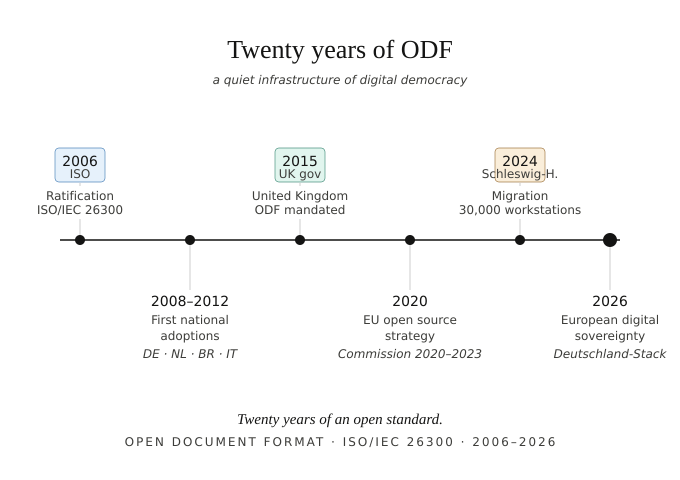 It is worth remembering that many of those who champion Digital Sovereignty today were silent back in 2006, when the open ISO/IEC ODF standard — the pillar of Digital Sovereignty — was announced: not only did they not listen to us during all these years, but in some cases they greeted us with a condescending smile.
If we can speak of Digital Sovereignty in Europe today, it is thanks to The Document Foundation and LibreOffice community members at large, who kept the flag of open-source office suites flying when everyone was predicting their demise, and who continued to develop the only truly open and standard format that guarantees Digital Sovereignty, as it provides full user control over content.
Document formats are a subject still rife with misinformation. This is understandable on the part of Microsoft, which developed and controls the horrible proprietary OOXML format, designed precisely to prevent Digital Sovereignty by maintaining content lock-in. It is far less understandable on the part of companies that claim to advocate open source, such as those promoting Euro-Office.
Euro-Office defaults to the fully proprietary OOXML document format, developed and controlled solely by Microsoft. This makes it a de facto ally of Microsoft in its content lock-in strategy, with control remaining firmly in Redmond and far from Europe.
So, despite what is being written in support of Euro-Office — the latest of the office suites developed in Europe, and not the first — the announcement is not against Microsoft. On the contrary, it strengthens Microsoft’s strategy against European Digital Sovereignty, or, if you prefer, against the freedom of European users to control and manage their own content.